Francesca Gino’s lawsuit against Harvard is still ongoing. (The trial, if it gets to that, is scheduled for December 2026) While the case drags on, both sides keep filing documents with the court, and most of those documents are publicly available (htm). This post is about a recent filing: Document #222 (pdf).
(this post is cross listed on substack htm)
The Cover-Up File
On October 1st, 2023, Gino claimed on her website francesca-v-harvard.org that she had found an Excel file that Harvard should have used in its investigation but didn’t. As she put it, “our unequivocal conclusion is that [Harvard Business School] used the wrong dataset in its investigation . . . The correct dataset . . . is 100% consistent with the [published results]” (htm) [1].
Note: in this post, text appearing in [brackets] within quotations indicates that the quote has been edited for clarity.
Harvard countered that the file “was fabricated by Professor Gino and placed on her laptop” [2].
Harvard refers to this file as the “Cover-Up File”, and I will follow suit.
Gino took her post down, but did not recant her claims about the Cover-Up File [3].
Document #222 is key in Harvard’s claim of a Gino cover-up. The document includes a 42-page PDF containing a data-forensic report by Julian Ackert (htm), an expert hired by Harvard. The report lays out extraordinarily detailed information about computer files moving in and out of Francesca Gino’s laptop over the years.
**
To get started, imagine you were the analyst tasked with evaluating the legitimacy of the Cover-Up File. What’s the first step you need to take? Finding the file.
Step 1: Finding the Cover-Up File
Harvard had two copies of Gino’s work laptop. One from when they started the investigation in the Fall of 2021, the second from the tenure revocation proceedings in 2024. The forensic analyst found the Cover-Up File only in the 2024 copy. In the 2021 copy, there is a file with the same filename, in the exact same folder, but with different contents [4]. This isn’t great for Gino’s story.
Step 2: When was the Cover-Up File added to Gino’s laptop?
Because the file was found in the 2024 but not the 2021 copy of Gino’s laptop, we know it was added between those years. That’s a wide window. Exactly when it was added seems forensically relevant.
Helpfully, computers keep track of these things. Most relevant to us, they record in the “last-modified” field of each file, when they were last saved. For Excel files, last-modified times are saved in two places:
- In the Excel file itself (henceforth, the Excel date)
- In the operating-system’s file catalog (henceforth, the macOS date)
The Excel date for the Cover-Up File is “September 23rd, 2023″ [5]. That’s just eight days before Gino wrote on her website about finding the file. This sounds bad, but it need not be. If Gino found the file it would make sense for her to open it. If she then saved it (possibly with auto-save), the Excel date would update. All we learn from this timestamp is that someone using Gino’s laptop accessed the Cover-Up File on September 23rd, 2023.
The macOS date for the Cover-Up File, in contrast, is older, much older.
It is July 17th, 2010 [6]. So:
Excel said: “this file was last modified in 2023”.
macOS said: “this file was last modified in 2010”.
It turns out this pattern of dates, a macOS date 13 years before an Excel date, is “highly irregular” [7] and it led the forensic expert to conclude that the “metadata in the 2023 Cover-Up File was manually backdated” [8]. This means the macOS date was tampered with, it was manually moved back to 2010.
The underlying issue is this:
When you save an Excel file, both the the Excel date and the macOS date update (they match)
When you copy an Excel file, only the macOS date updates (so macOS is newer)
Because you can copy a file after you save it, but you cannot copy a file before you save it, the macOS date can be newer but not older than the Excel date.
OK. This leads to the next question: where was this backdated file before it was put on Gino’s work laptop?
Step 3: A Black USB Drive (Serial #: 21013403D7FFA005) [9] .
Mac computers have something called the “Unified Log”. It’s a record of actions taken on the computer. The log for Gino’s work laptop shows that on September 23rd, 2023, the day the Excel file was last saved, Gino’s work laptop was opened for the first time at 5:31 PM [10]. Just one minute later a black USB drive was inserted into the laptop, and 18 seconds later the Cover-Up File was copied onto the laptop [11].
The Cover-Up File had the same name as a file already in the folder it was copied into, so this means that the Cover-Up File literally covered up (i.e. replaced) an existing file [12].
The analyst notes that on a Mac computer, when copying a file that would overwrite an existing one, a warning pops up [13]. That warning would have looked something like this:
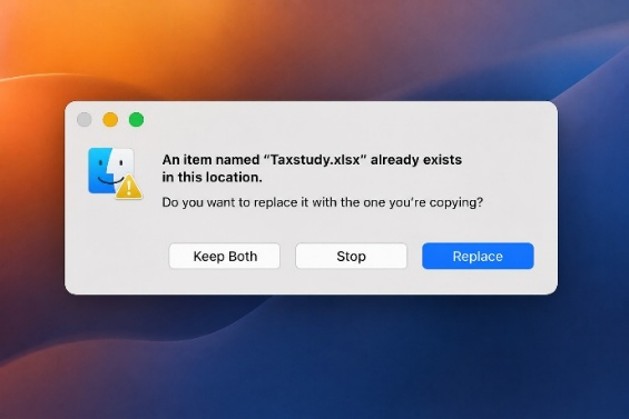
Figure 1. Illustration of a confirmation popup on a Mac computer
The user of Gino’s laptop must have clicked on “Replace”.
Step 4: Where did the file in the USB come from?
We can again rely on metadata to answer that. Metadata often don’t just tell you when something was saved, but also who saved it.
The username for Gino’s work laptop is “Francesca Gino” (with 2 spaces). The Cover-Up File in the USB drive was last saved on a computer with a different username: “Gino, Francesca”. The forensic analyst believes that “Gino, Francesca” is the username for a personal laptop Gino bought in 2023, suggesting that that’s where the Cover-Up File came from [14].
Step 5: Benjamin Edelman
The analyst also had access to a (redacted) copy of Gino’s Google Drive account. He states that Gino uploaded the Cover-Up File to Google Drive and shared a copy with Benjamin Edelman [15]. Edelman is a former HBS professor who got denied tenure, sued Harvard for it, and lost (but is now appealing, see his website: edelman-v-harvard.org). Harvard has been trying to get Edelman to testify under penalty of perjury on his dealings with the Cover-Up File, but he refused to do so during his deposition by asserting attorney-client privilege. (Edelman, who has a law degree from Harvard, has not formally represented Gino [16], but has advised her). As background: this post exists because Document #222 was made public, and it was made public because Harvard filed it to try to persuade the judge that Edelman should be compelled to answer questions about the Cover-Up File. The request got a surprising reject-and-resubmit a few days ago, see footnote for details [17].
The covered-up evidence
Document #222 also provides new (to me) evidence that Gino was responsible for the data anomalies in the sign-at-the-top experiment in the retracted PNAS paper. Specifically, it shows that there is simply too little time for anybody but Gino to have generated those anomalies. I summarize the key relevant events in Table 1 below [18].
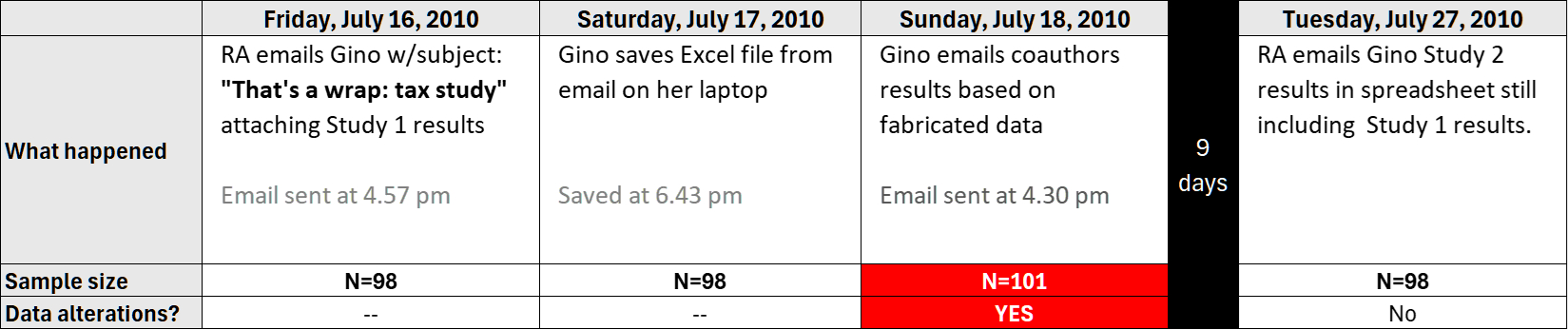 Table 1. The sequence of events for fabricated Study 1 in retracted PNAS paper.
The story begins on Friday July 16th, when at 4:57 PM Gino’s inbox receives an email from the Research Assistant with the subject line “That’s a wrap: tax study” for Study 1. Gino saves that file on her computer the next day, Saturday at 6:43 PM. Less than 22 hours later, on Sunday at 4:30 PM, she has already emailed her co-authors results based on a copy of that file that has anomalies: 3 extra observations, N=101 instead of N=98, and many cell value changes. This short time span between the clean and the anomalous versions of the same dataset being saved on Gino’s computer is what a backdated copy of the anomalous dataset, the Cover-Up File, would cover up.
One last thing. Nine days after Gino sends the anomalous results for Study 1 to her coauthors, the RA fortuitously resends Gino the Study 1 data. The RA was sending Gino partial data for Study 2, and she happened to put those new results in the same spreadsheet she had used for Study 1. Those Study 1 data that were resent by the RA still did not have any of the documented anomalies.
Julian Ackert, again, Harvard’s forensic analyst, writes “If [the RA] had participated in a modification of the raw data [that Gino sent coauthors] . . . it is implausible that she would continue using the raw data” [19].
In a visual nutshell, this is Harvard’s story: 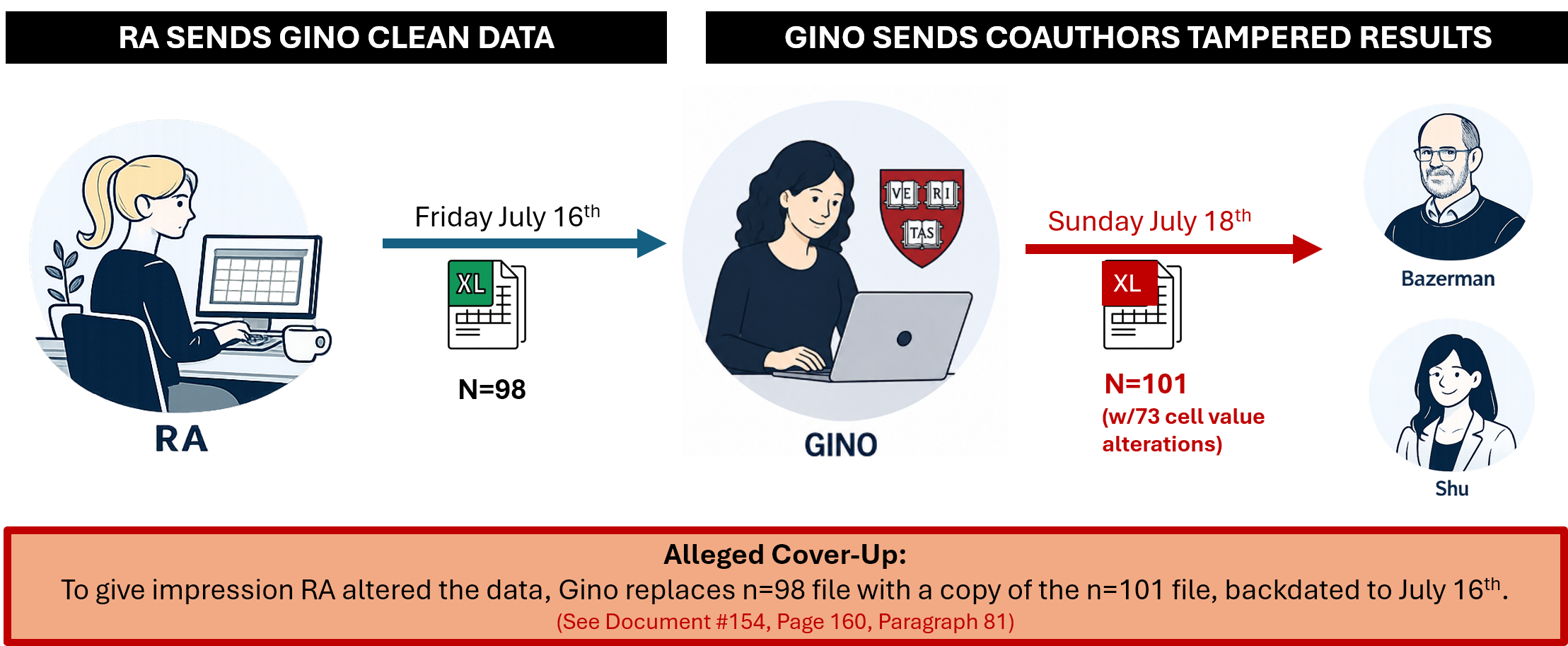
Further reading
Colada[109] “Clusterfake”: Original post documenting evidence of fraud in this PNAS study.
Colada[114] “Exhibits 3,4 an 5”: Follow-up post showing exhibits from Gino’s own lawsuit against us supported our allegations.
Author Feedback
Our policy is to reach out to authors whose work we discuss and solicit feedback. In lieu of reaching out to Gino we quote from her affidavit filed with her opposition to Harvard’s motion to compel Edelman to answer questions about the Cover-Up File: [20] “[Harvard’s] allegations of data fabrication and evidence destruction are false and unfounded. Neither I, nor anyone acting on my behalf, created a backdated file to fabricate evidence. Nor did I, or anyone acting on my behalf, overwrite any file data in an effort to destroy evidence . . . The so-called [Cover-Up File] is a genuine file that I found in or about the summer of 2023 when searching through materials that had been stored in my former office at Harvard . . . “
Footnotes.
- Gino’s removed blog post:
The original URL for the now removed post was https://www.francesca-v-harvard.org/hbs-data-reconciliation-1, but the link no longer works. If you visit it now, June 2026, it redirects to a generic landing page for a redesigned webpage (htm) where Gino claims that “For transparency, I am leaving the original website live. It launched on September 29 2023, but it is now not up to date“. But that is not entirely true. The removed blogpost was in the original website and it is not live. It is, however, on the web archive (htm).[↩] - See Document #154, page 162, paragraph 90 (pdf)[↩]
- See Document #216, an affidavit by Gino (pdf).[↩]
- See Document #222, paragraph 41.[↩]
- See Document #222, Figure 4.[↩]
- See Document #222, Figure 4 (same as previous footnote).[↩]
- See Document #222, paragraph 45[↩]
- See Document #222, page 19, section header.[↩]
- See Document #222, paragraph 57.[↩]
- See Document #222, paragraph 56.[↩]
- See Document #222, paragraph 58.[↩]
- See Document #222, paragraph 59.[↩]
- See Document #222, paragraph 59.[↩]
- See Document #222, paragraph 55.[↩]
- See Document #222, paragraph 68.[↩]
- See Document #207, page 10, footnote 6 where Harvard states that “Edelman has never made an appearance on behalf of [Gino] in this litigation or in her tenure proceeding”. (pdf) [↩]
- Harvard’s request for compelling Edelman’s testimony got a Reject and Resubmit.
It turns out that Harvard filed the request to compel Edelman’s testimony in the wrong court (See Document 229 page 2 (pdf) ). Because Edelman lives in the state of Washington, and thus would be deposed in Washington, Harvard should have submitted the request to compel his testimony to a Washington court, but it filed it instead in the court where all other proceedings are taking place, and all other documents were filed; a Massachusetts court. Harvard could resubmit to the Washington court if they wanted. In that same court document (See Document 229 pages 3 & 4 (pdf) ) the court orders Gino’s husband, Mr. Burd, to answer a question about conversations he had with Edelman about the Cover-Up File. Mr. Burd had also declined to provide that information in his deposition alleging attorney-client privilege, but he lives in Massachusetts, so Harvard’s request that he be compelled to answer was submitted to the right court, and the judge agreed he should be compelled.[↩] - See Document #222, Figure 3[↩]
- See Document #222, Paragraph 33.[↩]
- See Document #216, Paragraphs 2 & 3 (pdf).[↩]